AI-Based Steering Models are Stuck in the Simulation Loop
You are running billions of simulation miles, but you still cannot guarantee that your neural network policies are safe in unseen edge cases.
The Three Crucial Validation Bottlenecks
The Simulation Paradox
Generating millions of random test scenarios increases compute overhead but does not identify the underlying structural stability of deep neural policies. You are collecting data, not guarantees.
The Edge-Case Blindspot
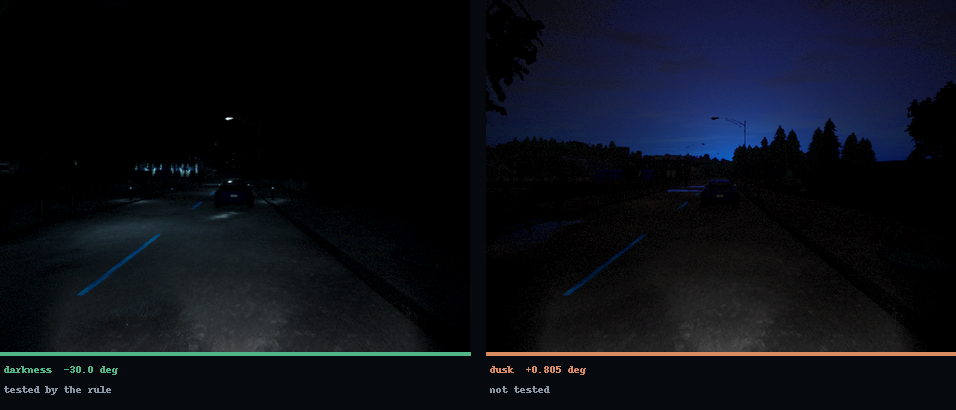
Continuous physical perturbations—like sudden contrast drops, glare events, or active snowfall—trigger unpredictable output steering deviations. Reactive log playbacks and scenario engines miss these boundary transitions entirely.
The Late-Discovery Penalty
Safety-critical model failures are discovered at the very end of the SIL/HIL testing cycle. This late-stage discovery forces developers into costly model redesigns, resetting timeline projections and delaying market launch.
Why Traditional Autonomy Tooling is Failing
Modern autonomous vehicle validation teams are overwhelmed by data. Standard workflows rely on massive, sampling-based scenario generation and log playback. These tools treat the neural network controller as a black box. They generate infinite variations of the environment but fail to evaluate the structural integrity or output boundaries of the policy itself.
When driving models encounter situations outside their training support or undergo sensor perturbations (e.g., lens occlusion, adverse weather), they exhibit non-linear steering anomalies. Finding these faults by chance requires an infinite search space.
To deploy with confidence, safety and validation engineers need a way to proactively audit and prioritize test scenarios and model stability before running physical or expensive simulation trials.
Are you actively struggling to validate and deploy end-to-end AI steering models?
We are speaking with validation leads, simulation engineers, and safety directors at automotive OEMs and Tier-1 suppliers to study this bottleneck.
Let's talk